Bitcoin Miners Pay Paraguay $350 Million Annually, but AI Data Centers Are Pushing Them Out
Paraguay's Bitcoin miners reportedly pay ANDE $350 million annually, but AI data centers, higher power tariffs and grid bottlenecks are reshaping demand for hydroelectric energy.
Editorial note
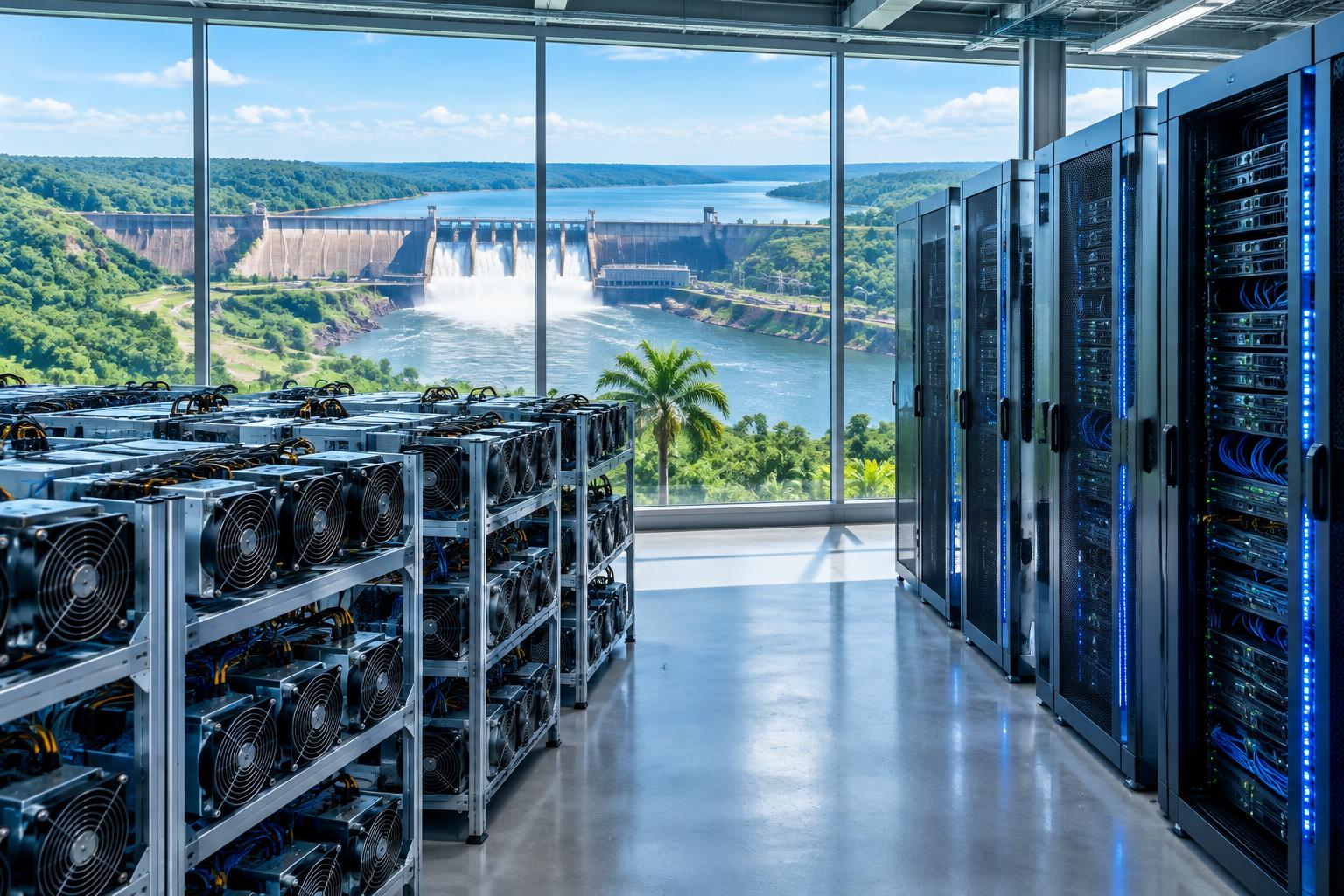
This article was prepared by the MediaPull Editorial Team from a submitted report. MediaPull has not independently verified the $350 million revenue estimate, power-contract priorities or facility conversions described below. Source names were supplied with the report, but no specific report links were provided. Consult original ANDE disclosures and publisher reports before relying on these claims. The cover is a conceptual illustration, not a photograph of a reported facility.
Paraguay's hydroelectric grid faces competing demand
ASUNCIÓN — Cryptocurrency mining operations currently pay Paraguay’s state-owned power utility roughly $350 million per year, yet an accelerating wave of artificial intelligence (AI) infrastructure demand is rapidly displacing miners from the South American nation's abundant hydroelectric grid.
A $350 Million Revenue Engine Under Pressure
Powered almost entirely by massive hydroelectric facilities—most notably the Itaipú Dam shared with Brazil—Paraguay has long attracted industrial Bitcoin miners seeking cheap, renewable surplus electricity. Licensed crypto mining facilities have become major commercial customers for the National Electricity Administration (ANDE), generating an estimated $350 million in annual revenue for the state utility.
However, shifting economic realities, regulatory friction, and competing demand from global technology companies are reshaping how Paraguay allocates its finite grid capacity:
- Power Tariff Hikes and Crackdowns: Repeated electricity rate increases enacted by ANDE, alongside strict enforcement against unlicensed operations, have compressed profit margins for traditional proof-of-work miners.
- Grid Capacity Caps: While Paraguay generates a surplus of clean power, limited high-voltage transmission and substation infrastructure has created bottlenecks, forcing policymakers to prioritize which energy-intensive industries receive long-term power contracts.
- The AI Pivot: Well-capitalized AI hyperscalers and high-performance computing (HPC) operators are aggressively competing for the exact same power substations and land footprints previously occupied by Bitcoin farms.
Why AI Operators Are Outbidding Crypto Miners
The transition from Bitcoin mining to AI compute reflects a broader global trend across energy-rich jurisdictions. Unlike Bitcoin miners—whose profit margins fluctuate wildly with crypto market cycles and block-reward halvings—AI data center operators generate substantially higher revenue per megawatt of electricity consumed.
- Superior Unit Economics: Cloud and AI compute providers can absorb higher industrial electricity tariffs while still maintaining strong operating margins, allowing them to outbid crypto miners for multi-year power purchase agreements.
- Government and Institutional Support: Paraguayan officials and regional economic planners increasingly view AI data centers as higher-value long-term investments capable of attracting sustained foreign direct investment, fiber-optic upgrades, and skilled technical employment.
- Site Conversions: Several major mining firms operating in Latin America and globally have already begun retrofitting existing facilities—or selling off energized sites—to host GPU clusters for artificial intelligence workloads.
Outlook for Paraguay’s Digital Infrastructure
While licensed Bitcoin miners continue to contribute hundreds of millions of dollars to Paraguay’s public coffers, industry observers note that the era of cheap, uncontested hydroelectric power for crypto mining is closing. As global demand for AI compute accelerates, Paraguay’s clean energy surplus is steadily shifting from securing the Bitcoin blockchain to powering next-generation artificial intelligence infrastructure.
Sources
Compiled from Paraguay National Electricity Administration (ANDE) disclosures, regional energy market reports, CoinDesk, and Bloomberg (as supplied with the submitted report; specific links were not provided).
Tags: #Bitcoin #CryptoMining #Paraguay #ArtificialIntelligence #AIDataCenters #CleanEnergy #CryptoNews #TechNews
For informational purposes only. This article is not financial advice.
Comments (0)
Loading comments…