Fixed-Rate vs. Variable-Rate Loans: How Interest Rate Shifts Impact Monthly Amortization
Fixed-rate loans lock your payment; variable rates move with the market. See how rate changes alter amortization, monthly payments and total interest paid.
Introduction: the most important choice in borrowing
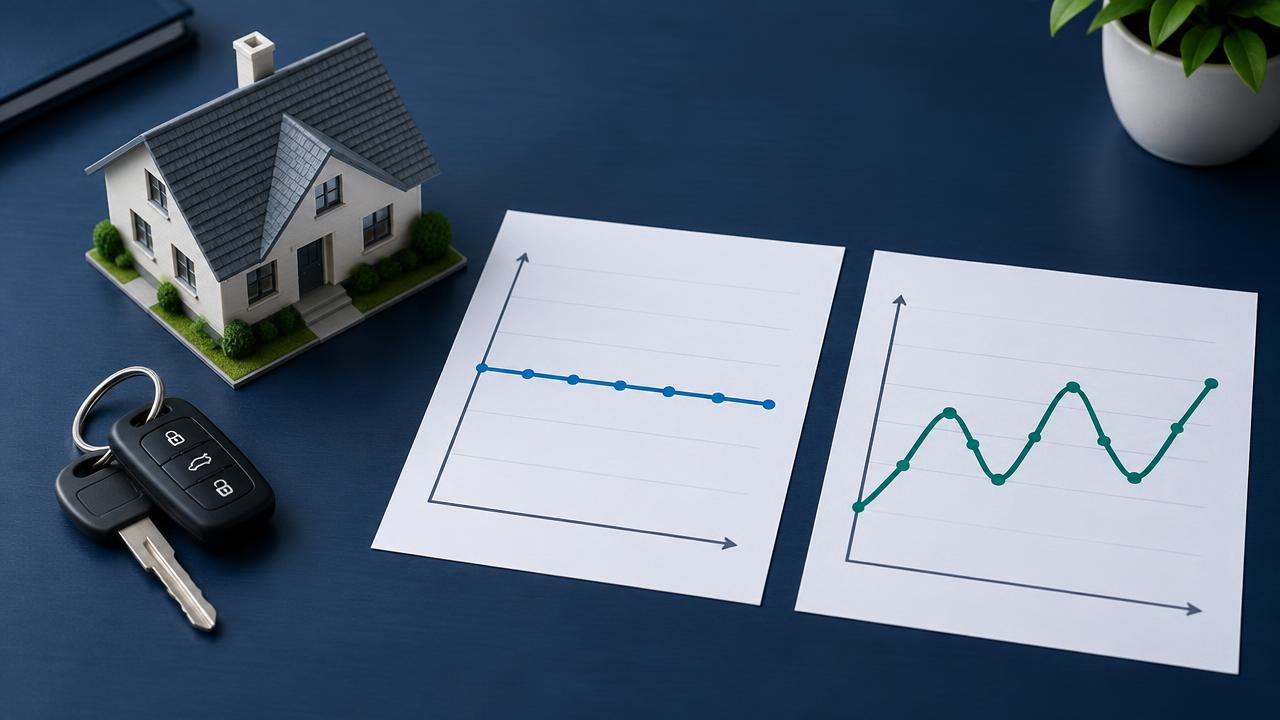
When you take out a mortgage, car loan or business loan, the interest rate structure shapes every payment you will make. A fixed-rate loan keeps the same rate for the full term, so each instalment stays constant. A variable-rate, or adjustable-rate, loan ties the rate to a benchmark such as a central-bank policy rate or an interbank index, plus a fixed margin. When the benchmark changes, so does your payment.
Neither structure is universally better. The right choice depends on the starting rates offered, how long you plan to keep the loan, your budget's tolerance for change and your expectations for interest rates.
- Key takeaway: fixed rates trade a usually higher starting rate for payment certainty.
- Key takeaway: variable rates start lower but expose borrowers to rising payments.
- Key takeaway: a one-percentage-point rise on a $300,000, 30-year loan adds roughly $200 a month.
How amortization works
Amortization is the process of repaying a loan through regular instalments that cover both interest and principal. In the early years, most of each payment goes toward interest because the outstanding balance is large. As the balance falls, the interest portion shrinks and more of each payment reduces principal.
With a fixed-rate loan, the schedule is set on day one. With a variable-rate loan, the lender recalculates the payment at each reset, using the remaining balance, the remaining term and the new rate. That means a rate increase late in the loan has a smaller effect than one early on, because less principal remains.
Monthly payment = P × i ÷ (1 − (1 + i)^−n)
P = principal, i = monthly rate (annual ÷ 12), n = number of payments
A worked example: the cost of a rate shift
Take a $300,000 loan repaid over 30 years. At a fixed 6.5%, the monthly payment is about $1,896. The table shows how the payment changes at other rates. A borrower whose variable rate rises from 5.5% to 7.5% would see the monthly cost climb from roughly $1,703 to $2,098, an increase of nearly $395 a month or more than $4,700 a year.
| Interest rate | Monthly payment | Total paid over 30 years |
|---|---|---|
| 5.5% | $1,703 | ≈$613,000 |
| 6.5% | $1,896 | ≈$683,000 |
| 7.5% | $2,098 | ≈$755,000 |
| 8.5% | $2,307 | ≈$830,000 |
Adjustable-rate structures and caps
Many variable-rate mortgages begin with an introductory fixed period, such as five or seven years, before adjusting annually. Consider a 5/1 adjustable loan of $300,000 at 6.0%. The initial payment is about $1,799. After five years the balance is roughly $279,200. If the rate resets to 8.0% for the remaining 25 years, the payment rises to about $2,155 — an increase of around $356 a month.
Lenders usually limit such jumps with caps: a limit on the first adjustment, a limit on each later adjustment, and a lifetime ceiling. A common structure is 2/2/5, meaning the rate can rise no more than two points at the first reset, two points at subsequent resets, and five points over the life of the loan. Borrowers should calculate the payment at the lifetime cap to test whether it would remain affordable.
Some markets also use tracker loans that follow the central-bank rate directly, and offset or redraw facilities that reduce interest by linking savings to the loan balance. These features can lower costs but make payments even more sensitive to policy decisions.
Choosing between fixed and variable
Fixed rates suit borrowers who value predictability, expect to hold the loan for many years, or are borrowing when rates are low by historical standards. Variable rates can suit borrowers who expect rates to fall, plan to sell or refinance before the first reset, or have enough income headroom to absorb higher payments. Break costs also differ: fixed loans in some countries carry penalties for early repayment, while variable loans are often more flexible.
Stress-testing is essential either way. Calculate your payment at rates two or three percentage points above today's level and confirm your budget, including your emergency fund, could cope. Remember that property taxes and insurance, often collected with the loan payment, can also rise over time and add to the total monthly cost. Our mortgage calculator makes these comparisons quick.
Conclusion
Keep records of each rate reset notice and compare it with your own calculation, since errors in adjustment are not unheard of. Fixed-rate loans buy certainty; variable-rate loans offer potential savings in exchange for risk. Because a single percentage point can change a 30-year mortgage payment by hundreds of dollars a month, run the numbers at several rates before signing, read the caps carefully, and choose the structure that your budget could survive in a rising-rate environment.
For informational purposes only. This article is not financial advice.
Comments (0)
Loading comments…