Compound Interest vs. Simple Interest: Visualizing Long-Term Wealth Growth Over 20 Years
Simple interest grows in a straight line; compound interest accelerates. Compare both over 20 years with tables, formulas and the effect of extra deposits.
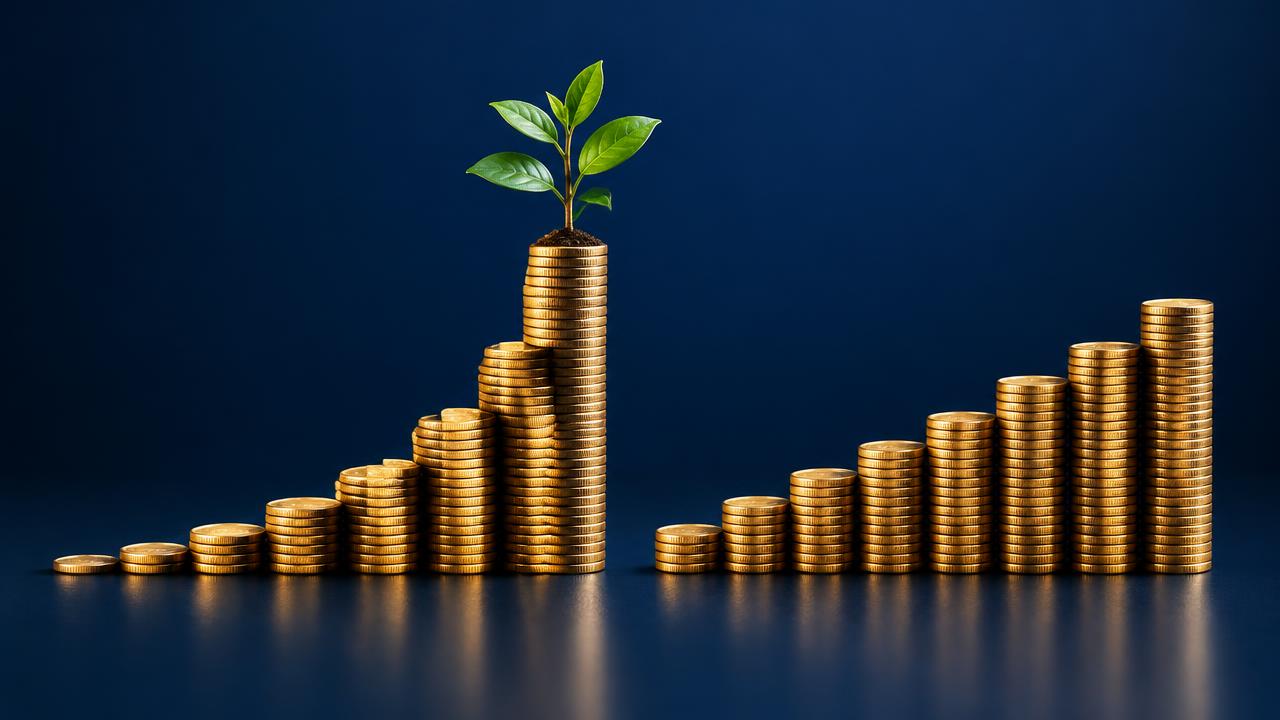
Introduction: two ways money grows
Every savings account, bond, loan and investment return can be described by one of two interest methods. Simple interest pays a return only on the original amount. Compound interest pays a return on the original amount plus all interest already earned. Over a year or two the difference looks small. Over twenty years it can mean tens of thousands of dollars, which is why understanding it is one of the most valuable lessons in personal finance.
- Key takeaway: simple interest grows by the same amount every year; compound interest grows by a larger amount each year.
- Key takeaway: at 7% over 20 years, compounding more than doubles the interest earned compared with simple interest.
- Key takeaway: compounding frequency, rate and time all matter, but time has the greatest effect.
The two formulas
Simple interest multiplies the principal by the rate and the number of years. If you invest $10,000 at 7% simple interest, you earn $700 every year regardless of how much has accumulated. Compound interest raises the growth factor to the power of the number of periods, so each year's interest is calculated on a bigger balance.
Compounding frequency adds a smaller effect. At 7%, annual compounding turns $10,000 into $38,697 over 20 years, while monthly compounding produces about $40,387. Daily compounding adds only a little more. Banks often quote the annual percentage yield (APY), which already includes compounding, so comparing APYs rather than headline rates gives a fairer comparison between accounts.
Simple interest is common in short-term loans, some car loans, certain bonds that pay coupons in cash, and many informal lending arrangements. Compound interest applies to most savings accounts, reinvested investment returns, and credit-card balances that accumulate unpaid interest.
Simple: A = P × (1 + r × t)
Compound: A = P × (1 + r ÷ n)^(n × t)
P = principal, r = annual rate, t = years, n = compounding periods per year
Twenty years side by side
The table compares $10,000 invested at 7% a year under each method, with compound interest calculated annually. Both start identically, but the compound line bends upward. The simple line rises by exactly $700 a year, while the compound balance adds $700 in the first year, about $1,290 in year ten and more than $2,500 in the final year, because each year's interest is earned on a larger base. By year ten, compounding has produced about $2,672 more; by year twenty, the gap is nearly $14,700 — compound interest has earned $28,697 against $14,000 of simple interest.
| Year | Simple interest balance | Compound interest balance | Difference |
|---|---|---|---|
| 0 | $10,000 | $10,000 | $0 |
| 5 | $13,500 | $14,026 | $526 |
| 10 | $17,000 | $19,672 | $2,672 |
| 15 | $20,500 | $27,590 | $7,090 |
| 20 | $24,000 | $38,697 | $14,697 |
A worked example: adding monthly deposits
Regular contributions magnify the effect. Suppose an investor starts with $10,000 and adds $200 a month for 20 years, earning 7% compounded monthly. Total deposits reach $58,000. Using the future-value formulas, the starting sum grows to about $40,387 and the monthly deposits to about $104,185, for a combined balance of roughly $144,570. More than $86,000 of that comes from interest and growth, not deposits.
Under simple interest, the same deposits would earn interest only on each contribution, not on prior interest, producing a balance far lower — roughly $97,000. The gap illustrates why reinvesting returns, rather than withdrawing them, is central to long-term wealth building.
FV of lump sum = 10,000 × (1 + 0.07/12)^240 ≈ $40,387
FV of deposits = 200 × [((1 + 0.07/12)^240 − 1) ÷ (0.07/12)] ≈ $104,185
Total ≈ $144,570
When compounding works against you
The same mathematics applies to debt. A $5,000 credit-card balance at 22% interest compounded monthly grows to about $6,218 in a single year if left unpaid, and more than doubles in under four years. Paying high-interest debt early is therefore one of the highest guaranteed returns available. Fees on investments also compound: a 1% annual fee can reduce a 20-year balance by around 17%, which is why low-cost funds matter. Our simple interest calculator is useful for comparing flat-rate loans with compounding alternatives.
Conclusion
Simple interest produces a straight line; compound interest produces a curve that steepens with every year. Over two decades, compounding can turn the same rate into nearly twice the interest. Use the formulas or a calculator to test different rates and time horizons before choosing an account or investment. Start early, reinvest returns, add regular deposits, keep fees low and avoid compounding debt. The earlier you begin, the more of your final balance will come from growth rather than your own contributions.
For informational purposes only. This article is not financial advice.
Comments (0)
Loading comments…