The US Dollar Index (DXY) Explained: Why Dollar Strength Pressures Emerging Markets and Commodities
The DXY measures the dollar against six major currencies. Learn how it is built and why a strong dollar weighs on commodities and emerging economies.
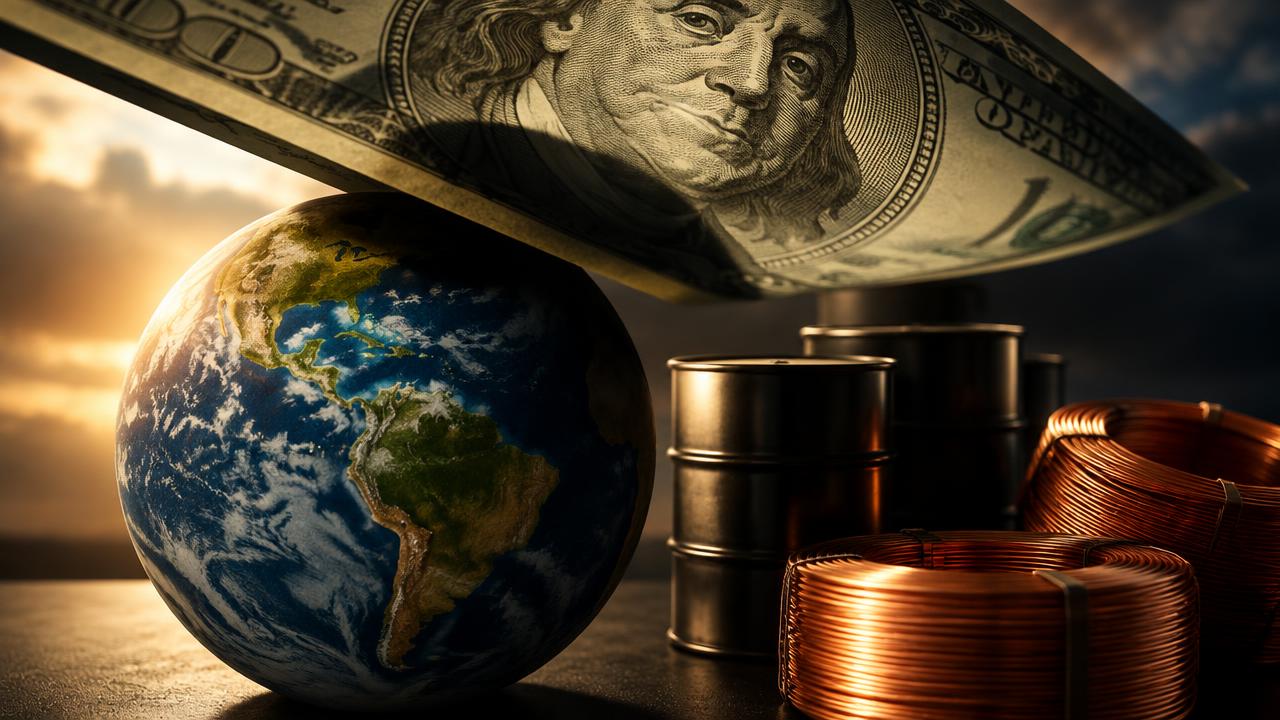
Introduction: the world's most watched currency gauge
The US dollar is the world's primary reserve currency, the main currency for commodity pricing and the dominant unit for international borrowing. Because so much of the global economy depends on it, the dollar's strength or weakness affects everything from oil prices in Asia to debt repayments in Latin America. The US Dollar Index, widely known by its ticker DXY, is the most common way to track the dollar's overall value against other major currencies.
- Key takeaway: the DXY compares the dollar with six currencies, and the euro accounts for more than half of the index.
- Key takeaway: a rising DXY usually means lower dollar prices for commodities such as gold and oil.
- Key takeaway: dollar strength raises the cost of dollar-denominated debt for emerging economies.
How the DXY is constructed
The index was established in 1973, shortly after the end of the Bretton Woods system of fixed exchange rates, with a base value of 100. It is a geometrically weighted average of the dollar's value against six currencies. The weights were last changed in 1999 when the euro replaced several European currencies, and they have not been updated since — so the index does not include the Chinese yuan or the Mexican peso, despite their importance in US trade.
A reading of 105 means the dollar is about 5% stronger against the basket than at the 1973 base; a reading of 95 means it is about 5% weaker. Because of the euro's heavy weight, the DXY often moves as a mirror image of EUR/USD. Broader trade-weighted indices published by the Federal Reserve include more currencies and better reflect US trade patterns.
| Currency | Weight in DXY |
|---|---|
| Euro (EUR) | 57.6% |
| Japanese yen (JPY) | 13.6% |
| British pound (GBP) | 11.9% |
| Canadian dollar (CAD) | 9.1% |
| Swedish krona (SEK) | 4.2% |
| Swiss franc (CHF) | 3.6% |
What drives the dollar
Interest rate differentials are the most powerful driver: when US yields rise relative to those abroad, capital flows into dollar assets. Relative economic growth matters too, as does risk sentiment. During global crises, investors often buy dollars and US Treasuries as safe havens, strengthening the dollar even when the shock originates in the United States. Trade balances, fiscal policy and central-bank reserve decisions influence longer-term trends.
Why a strong dollar pressures commodities and emerging markets
Commodities are priced in dollars. When the dollar strengthens, oil, copper, wheat and gold become more expensive for buyers using other currencies, which tends to reduce demand and push dollar prices lower. The relationship is not mechanical — supply shocks can lift commodities and the dollar together — but it is one of the most persistent patterns in markets.
Emerging markets face a second channel through debt. Many governments and companies borrow in dollars because rates are lower or investors demand it. Suppose a company in an emerging market owes $10 million when the local currency trades at 5 units per dollar. The debt equals 50 million in local terms. If the local currency weakens to 6 per dollar, the same debt becomes 60 million — a 20% increase in the real burden without any additional borrowing. Higher import costs and capital outflows can add inflation pressure, forcing local central banks to raise rates even as growth slows.
Commodity exporters can feel both effects at once: lower dollar commodity prices reduce export revenue just as their dollar debts become more expensive to service. Importers, by contrast, may see some relief from cheaper commodities, though weaker local currencies often offset it.
Local-currency debt = Dollar debt × Exchange rate
$10M × 5 = 50M; $10M × 6 = 60M (+20%)
What it means for investors
For US-based investors, a weaker dollar boosts the returns from foreign stocks and bonds when converted back into dollars, while a stronger dollar reduces them. Non-US investors holding dollar assets experience the opposite. Gold investors watch the DXY closely because a falling dollar has often coincided with rising gold prices. Many multinational companies also see reported earnings shrink when the dollar strengthens, because overseas sales translate into fewer dollars.
Currency-hedged funds can neutralise these effects, but hedging has its own cost, which depends on the interest rate gap between the two currencies.
Conclusion
The DXY is a simple but powerful summary of dollar strength. Because the dollar sits at the centre of trade, commodities and global borrowing, its movements ripple through commodity prices and emerging-market economies. Watch interest rate differentials and risk sentiment to anticipate its direction. For how exchange rates translate into local gold prices, read our guide on currencies and domestic gold markets.
For informational purposes only. This article is not financial advice.
Comments (0)
Loading comments…