Understanding Making Charges, Spreads, and Bid-Ask Margins When Buying Retail Gold
Retail gold costs more than spot. Learn how making charges, dealer spreads, bid-ask margins and taxes add up, and how to find your true break-even price.
Introduction: why you never pay spot
The spot price of gold is a wholesale benchmark for large bars traded between banks. Retail buyers pay more because every step between the refinery and the shop counter carries a cost: fabrication, distribution, insurance, retail rent and profit. When selling, they receive less than spot for similar reasons. The gap between the two is the true cost of owning gold, and it varies enormously between a plain investment bar and an intricate necklace.
- Key takeaway: making charges apply mainly to jewelry and can range from a few percent to over 25% of metal value.
- Key takeaway: the bid-ask spread is the difference between a dealer's selling and buying price.
- Key takeaway: your break-even is the gold price rise needed to cover all buying and selling costs.
Making charges on jewelry
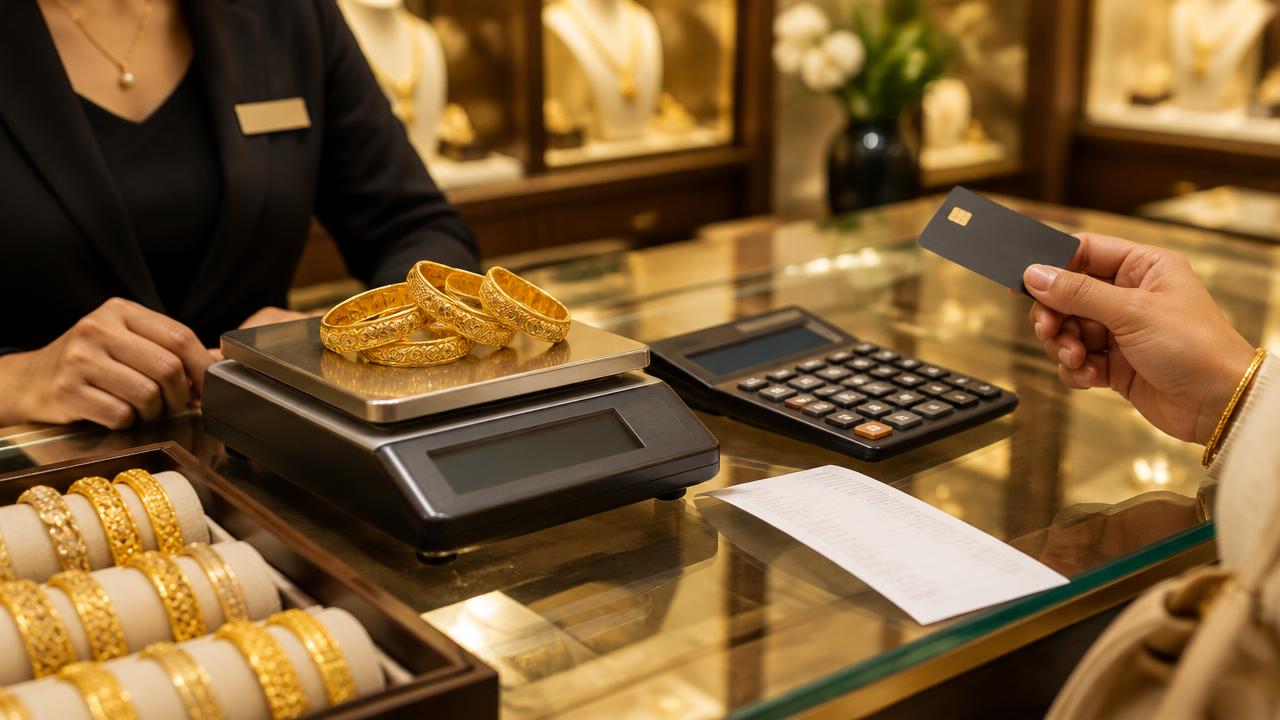
Making charges compensate jewelers for design, labour, wastage and finishing. They are quoted either as a percentage of metal value, a fixed amount per gram, or a flat fee per piece. Machine-made chains and plain bangles may carry charges of around 3% to 8%, while handcrafted, filigree or designer pieces can exceed 20%. In markets such as India and the Gulf, separate line items for metal value, making charges and tax are common, which makes comparison easier.
Buyers should also understand wastage. Some jewelers add a separate wastage percentage, representing gold lost during cutting, soldering and polishing, on top of labour. Others fold it into a single making charge. Asking whether wastage is included avoids paying for it twice, and comparing the total charge per gram across shops gives a fair like-for-like view of price, regardless of how each seller presents the bill.
Making charges are almost never recovered on resale. A jeweler buying back a piece typically pays for gold content only, sometimes minus a deduction for melting and refining. That is why jewelry is a poor short-term investment, even though it carries cultural and personal value.
Spreads and bid-ask margins on bullion
Investment bars and coins are sold at a premium over spot and bought back at a discount. A dealer's ask (selling) price and bid (buying) price together define the spread. Large bars from recognised refiners carry the tightest spreads; small bars and coins carry wider ones because production and handling costs are spread over less metal. Spreads also widen during periods of market stress, when demand for small products surges.
| Product | Typical buy premium | Typical sell discount | Round-trip cost |
|---|---|---|---|
| 1 kg bar | 0.5%–2% | 0%–1% | ≈1%–3% |
| 1 oz bar | 2%–5% | 0%–2% | ≈3%–7% |
| 1 oz sovereign coin | 3%–8% | 0%–3% | ≈4%–10% |
| Machine-made jewelry | 5%–15% incl. charges | 2%–10% | ≈8%–25% |
| Designer jewelry | 20%+ | Metal value only | Often 30%+ |
A worked example: your break-even price
Suppose spot gold is $77 per gram and you buy a 20-gram 22K bracelet. Gold content is 20 × 0.916 = 18.32 grams, worth about $1,410.64 at spot. The jeweler adds a 12% making charge ($169.28) and 5% VAT on the total ($79.00), for a final price of about $1,658.92. If you later sell to a buyer who pays 97% of gold value, you need gold to rise until 18.32 g × price × 0.97 = $1,658.92, which requires about $93.35 per gram — a 21% increase in the gold price just to break even.
By contrast, a 1-ounce bar bought at a 3% premium and sold back at 1% below spot needs only about a 4% price rise to break even. The difference shows why investors usually choose bullion, while jewelry buyers should consider making charges as consumption rather than investment.
Purchase cost = Metal value × (1 + making %) × (1 + tax %)
$1,410.64 × 1.12 × 1.05 ≈ $1,658.92
Break-even price/g = Cost ÷ (Pure grams × buyback %)
How to reduce what you pay
Ask for an itemised bill showing gold weight, purity, gold rate, making charge and tax. Compare the quoted gold rate with the live spot price converted to grams and your currency. For investment, choose larger standard products from reputable refiners and check the dealer's current buyback price before buying. Negotiate making charges on high-value jewelry, especially outside peak festival seasons, and avoid paying premiums on stones' weight. Our profit margin calculator can help you see how a dealer's markup compares with its margin.
Conclusion
Retail gold carries three layers of cost: making charges, bid-ask spreads and taxes. Together they can range from a few percent on large bars to a third of the price on designer jewelry. Calculate your break-even before every purchase, and match the product to your goal: bullion for investment, jewelry for wearing.
For informational purposes only. This article is not financial advice.
Comments (0)
Loading comments…